A marketing consultant is a strategic advisor who helps B2B businesses identify why their marketing is not driving growth, define who they should be targeting, and build a plan to fix it. Unlike a marketing agency, a consultant does not execute campaigns; they shape the strategy that makes execution effective.
You are spending on marketing. Maybe you have an agency running your ads. A team posting on social media. A designer producing brochures. And yet the leads are not coming in, or the leads are coming in, but they are the wrong ones. Or your sales team keeps saying that marketing isn't helping them close anything.
Something is off. But you cannot put your finger on what.
That is usually the moment a B2B business owner starts asking: "Do I need a marketing consultant?"
So, what does a marketing consultant do, and is it the right move for your business? Let's deep dive into it.
The Simple Answer Most People Get Wrong
A marketing consultant is not someone who runs your social media, designs your brochures, or manages your ad campaigns. That is the work of a marketing agency or an in-house execution team.
A marketing consultant is a strategic advisor. Their job is to look at your business from the outside, identify what is holding your growth back, and help you build a marketing direction that is aligned with your revenue goals.
Think of it this way: if your marketing is a vehicle, a consultant is not the driver; they are the navigator. They are the one who tells you whether you are heading in the right direction, whether the engine is built correctly, and whether the roads you are choosing will actually take you where you want to go.
What a B2B Marketing Consultant Actually Does
Audits Your Current Marketing Efforts
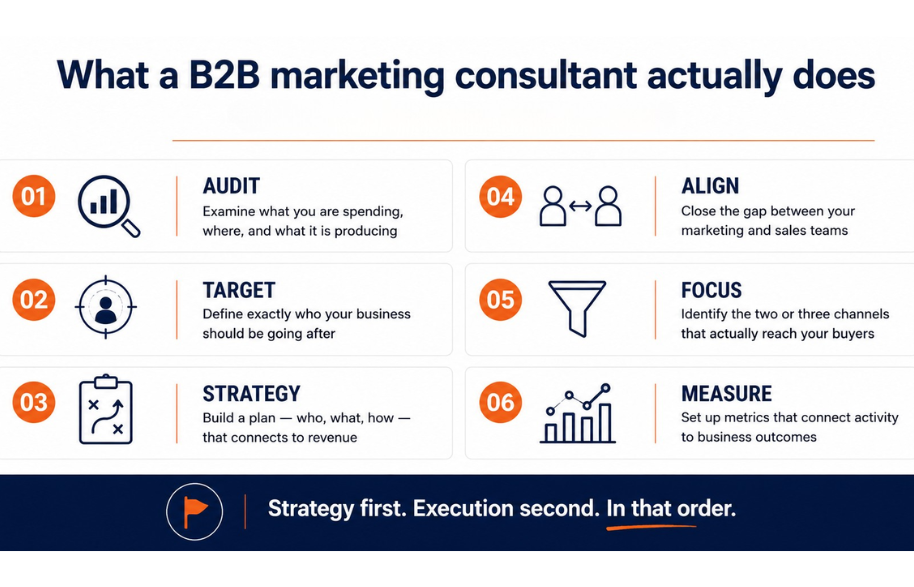
Before recommending anything, a good consultant will want to understand where you stand. This means examining your current lead-generation activity, how your sales and marketing teams are aligned (or not), which channels you are using, and the results those channels are producing.
In almost every audit, the same pattern shows up: a significant portion of marketing spend is going toward activity that has no connection to the pipeline. Businesses are surprised, not because they were careless, but because no one had ever mapped it out clearly before. An audit surfaces that.
Defines Who You Should Be Targeting
One of the most common problems in B2B marketing is a poorly defined ICP (ideal customer profile). Businesses often try to market to everyone and end up resonating with no one.
A consultant helps you get specific about the industries, company sizes, decision-makers, and pain points that your business is best positioned to solve. This specificity is what makes downstream marketing efforts far more effective.
Builds or Refines Your Marketing Strategy
Once the audit is done and the target is clear, a consultant develops a strategy. This is not a 60-page document that sits in a folder. It is a clear plan that answers three questions: who you are targeting, what you are saying to them, and how you are reaching them.
The strategy will typically cover channel selection, messaging, positioning, and how your marketing activity connects to your sales process.
Aligns Marketing with Sales
In B2B businesses, marketing and sales are often operating in separate lanes. Marketing generates leads that sales does not find useful. Sales makes promises that marketing cannot support. The result is friction and lost revenue.
A marketing consultant works to close that gap, ensuring that the leads your marketing produces are the leads your sales team can actually close, and that the handoff between the two functions is smooth.
Identifies the Right Channels
Not every business needs to be on every platform. A B2B manufacturing company has different channel needs than a professional services firm. A consultant helps you focus your time and budget on the channels that are most likely to reach your buyers — whether that is LinkedIn, email outreach, trade events, referral systems, or a combination.
Sets Up Measurement Frameworks
A consultant also helps you understand what to measure and why. Vanity metrics — impressions, follower counts, website visits in isolation are not useful if they do not connect to business outcomes. The right metrics depend on your stage of growth, your sales cycle, and your goals. A consultant defines those metrics and sets up the reporting structure to track them.
What a Marketing Consultant Does Not Do
This is equally important to understand.
A marketing consultant does not typically execute campaigns, write your content on a daily basis, or manage your paid media accounts. They advise, direct, and build the strategy. Execution is usually handled by your internal team, a marketing agency, or freelancers working within the framework the consultant has set.
Some consultants do offer execution support or work in a fractional capacity where they function as part of your leadership team. But even then, their primary value is strategic thinking, not task completion.
When Does It Make Sense to Hire a Marketing Consultant?
- Revenue is growing, but slowly, and you cannot identify why marketing is not accelerating it
- You are spending on marketing, but cannot draw a straight line from spend to leads
- Your sales team keeps saying the leads are not good enough
- You are entering a new market or launching a new offering, and have no clear go-to-market plan
- You have no senior marketing function internally, and strategy decisions are being made by instinct
- Marketing and sales are misaligned, and everyone knows it, but no one has fixed it
If two or more of these describe your business right now, the problem is almost certainly strategic. Adding more activity on top of a weak foundation does not fix the foundation.
If Any of That Felt Familiar, Let's Talk.
A free conversation is usually enough to tell you whether your marketing has a direction problem and what to do about it.
Talk to Maran
The Difference Between a Consultant and an Agency
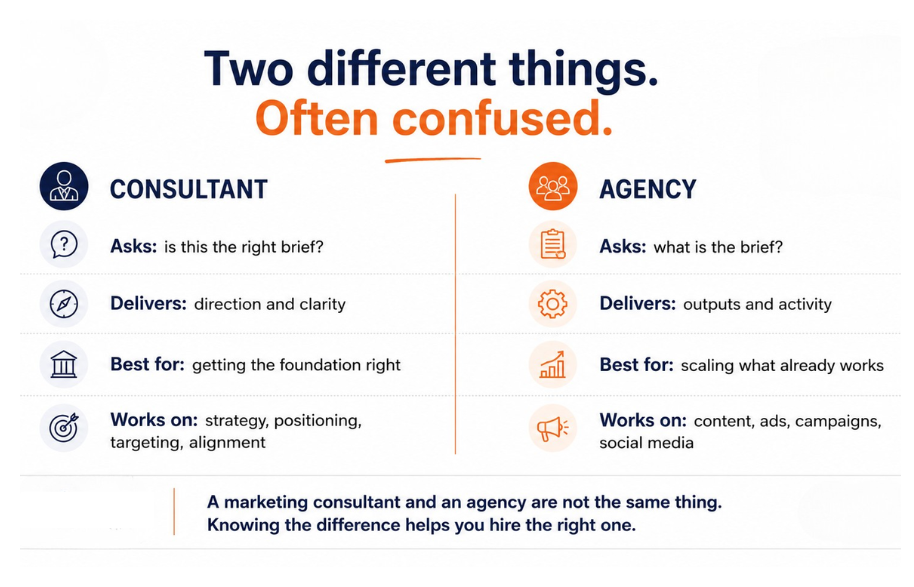
A marketing agency will take your brief, produce content or campaigns, and deliver outputs. A marketing consultant will question the brief, examine whether it is the right thing to be doing, and help you build a stronger one.
Some businesses need both — a consultant to shape the strategy and an agency to execute it. Others need the consultant to first fix the strategic foundation before any execution makes sense.
What to Look for When Hiring a Marketing Consultant
Not all consultants deliver the same value. When evaluating one, ask these questions:
- Do they have B2B experience? B2B marketing is structurally different from B2C. Sector familiarity matters.
- Do they have a clear process? Can they explain what they will do, what they will deliver, and by when? Vagueness in the scope of work is a red flag.
- Do they ask hard questions before offering answers? A consultant who jumps to recommendations before understanding your business is selling generic advice.
- Are they talking about pipeline and revenue? Or are they talking about reach and engagement? In B2B, only one of those conversations matters.
What Happens When Strategy Is Missing
Hiring a marketing consultant is not an admission that your marketing is broken. It is a recognition that strategic clarity is valuable and that an outside perspective, combined with deep expertise, can unlock growth that internal teams often cannot see.
For B2B businesses in particular, where sales cycles are long, buying decisions involve multiple stakeholders, and relationships matter enormously, getting the marketing strategy right is not optional. It is a competitive advantage.
At TheDIco, we work with B2B companies as a strategic growth partner. If you are trying to figure out where your marketing is falling short and what to do about it, we would be glad to start that conversation.
Talk to Maran
Frequently Asked Questions
What does a marketing consultant do?
A marketing consultant analyses a company's current marketing efforts, identifies gaps, defines the ideal customer profile, and builds a strategy aligned to revenue goals. They work across positioning, messaging, channel selection, and sales-marketing alignment — advising the business rather than running day-to-day campaigns.
What is the difference between a marketing consultant and a marketing agency?
A marketing agency executes campaigns, content, ads, and social media. A marketing consultant advises on strategy, who to target, what to say, and which channels to use. Many B2B companies benefit from both: a consultant to set the direction and an agency to carry it out.
When should a B2B company hire a marketing consultant?
A B2B company should consider a marketing consultant when growth has plateaued, marketing spend is not converting to leads, the sales team is chasing the wrong prospects, or there is no senior marketing function internally. A consultant brings an outside perspective and strategic clarity that internal teams often cannot generate alone.
How is a marketing consultant different from a fractional CMO?
A fractional CMO functions as a part-time senior marketing leader embedded in the business — attending leadership meetings, managing teams, and owning the marketing function. A marketing consultant is typically more project-based or advisory, brought in for a specific strategic problem or period. Some consultants offer both models.
What should I expect from a marketing consultant engagement?
Expect an audit of your current marketing, a defined strategy with clear recommendations, and a framework for execution. A good engagement ends with a documented plan your team can act on, not open-ended advice.
Filed under
- Marketing consultant
- Strategy
- B2B growth