The right time to hire a marketing consultant is when your business has revenue and customers, but growth has stalled, and your team cannot diagnose why. Other clear signals include over-dependence on referrals and a sales team that cannot convert leads marketing is sending.
In most cases, B2B founders ask this question too late. Not too late to fix things, but late enough that they've already spent money on the wrong solution. An agency that ran campaigns on a broken strategy. A content writer who produced content that went nowhere. An in-house hire who had no direction to work with.
Knowing when to hire a marketing consultant isn't about timing. It's about recognising the specific signals your business is sending and being honest enough to act on them.
You Don't Always Need a Marketing Consultant
Not every marketing problem is a consultant problem. If you need campaigns run, hire an agency. If you need content written, hire a freelancer. Knowing when to hire a marketing consultant starts with being honest about what's actually broken.
A consultant is not a vendor. You're not buying deliverables; you're buying a diagnosis. That distinction matters because the wrong hire at the wrong time doesn't just waste budget. It delays the real fix by months, leaving the actual problem unaddressed.
The question to ask yourself: do you know what's broken, or do you just know something isn't working? If it's the latter, that's where a consultant earns their place.
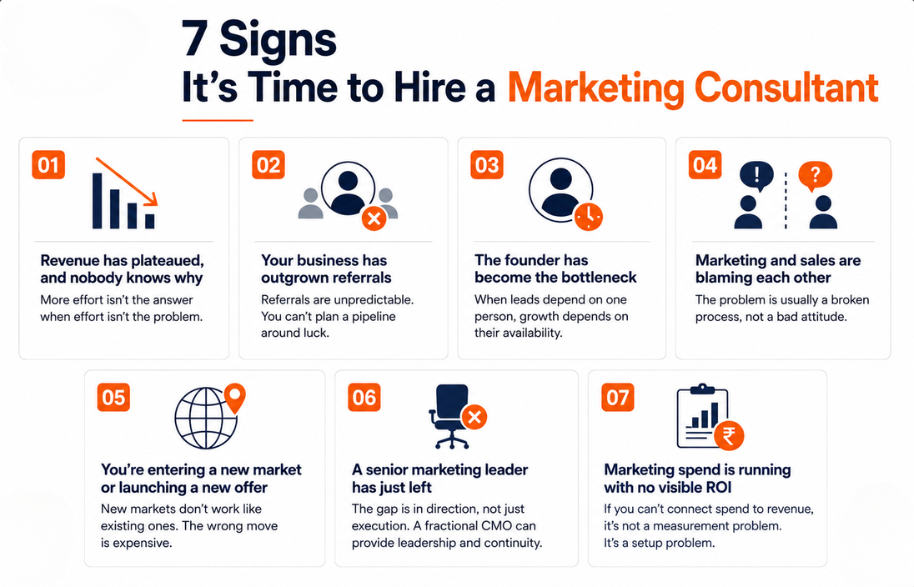
7 Signs It's Time to Hire a Marketing Consultant
1. Revenue has plateaued, and nobody knows why
The business is running, your team is working, and the campaigns are going out. But revenue has flatlined. This is the most common trigger and the most misdiagnosed. Most founders respond by doing more: more ads, more content, more outreach. But when effort isn't the problem, more effort isn't the solution. A consultant's job is to find what's actually blocking growth and name it clearly before recommending anything.
2. Your business has outgrown referrals
Many B2B businesses — especially in manufacturing, IT services, and professional services grow successfully for years without formal marketing. Many B2B businesses spend years growing entirely through relationships and word of mouth. That's not a weakness — it's proof the product works. But referrals are unpredictable.
You can't plan next quarter's pipeline around who your best client happens to mention you to. When a business can't answer the question "where will next quarter's pipeline come from?", it has outgrown the referral model. This is one of the clearest signs you need a marketing consultant.
3. The founder has become the bottleneck
This one is harder to see from the inside. The founder attends every networking event, handles key sales conversations, and generates most of the inbound interest through personal relationships.
It works until the founder runs out of hours. When lead generation depends entirely on one person being in the room, the business has a structural problem that no campaign will fix. A consultant can help build a system that generates leads independent of the founder's presence.
4. Marketing and sales are blaming each other
Marketing says we are getting good leads. Sales says the leads don't convert. Both are probably right, but each is probably looking at a different part of the same broken process.
When sales and marketing are misaligned, the problem is almost never attitude. It's a missing definition of what a qualified lead looks like, what the handoff process should be, and who owns which part of the buyer journey. A consultant can step in as a neutral third party and diagnose exactly where the breakdown is happening.
5. You're entering a new market or launching a new offer
New markets don't work like existing ones. Your current messaging, channels, and buyer assumptions may not carry over. This is high-stakes and time-sensitive. The wrong move here is expensive, and the cost of getting it right is relatively small compared to the cost of six months of misaligned execution. If you're expanding into a new segment or launching something new, knowing when to hire a marketing consultant is the difference between a structured entry and an expensive experiment.
6. A senior marketing leader has just left
In most cases, when a CMO or marketing director leaves, the gap is not just about execution but direction. Campaigns still need to run. The team still needs to function. But without senior strategic oversight, both tend to drift.
This is a natural moment to consider a fractional CMO. Someone who can step in part-time to provide the leadership and continuity your team needs while you figure out the right permanent hire. A fractional CMO oversees strategy and execution, not just advice.
7. Marketing spend is running with no visible ROI
If your answer to "what is our marketing producing in revenue?" is a long pause followed by some traffic numbers, that's the signal. Activity and outcomes are not the same thing. A consultant will look at where budget is going, what it's connected to, and what's actually moving the needle. In most cases, the problem isn't that marketing isn't working. It's because it's not set up to be measured against revenue.
If two or more of these signs sound familiar — don't hire anyone yet. Talk to us first. We'll tell you honestly what you need. Schedule a free 30 minute call with Maran.
When NOT to Hire a Marketing Consultant
This is the section most consultants won't write. But it matters.
- If you don't have product-market fit yet — a consultant won't fix that. No strategy will reliably generate demand for something the market hasn't validated.
- If you have no budget to implement the strategy — the engagement will produce a deck. The deck will sit in a folder. Nothing will change. A strategy without the capacity for execution is just documentation.
- If your sales process is broken — marketing can fill the top of the funnel. It cannot fix what happens inside a broken sales process. Sort that first, or you'll blame the consultant for leads that were never going to convert regardless.
Before You Make the Call — A Quick Internal Audit
Before reaching out to any B2B marketing consultant, answer these three questions honestly:
Can you name the single biggest reason leads aren't converting?
If yes, you have a diagnosis. You might need execution, not a consultant. If no, you need someone to find the answer before you spend another rupee acting on guesses.
Do you know which marketing activity is producing revenue?
If yes, you have data to build on. If no, you're optimising blind.
Is the problem a lack of ideas or a lack of direction?
Ideas are easy. Direction is what a consultant provides. If the team has plenty of ideas but no clarity on which ones to act on and why — that's the gap a consultant fills.
If you can't answer two or more of these clearly, you already know what you need.
Not sure whether what you're facing is a strategy problem or an execution problem?
Start with a conversation. We'll help you identify the real bottleneck — before you spend another rupee on marketing. Talk to Maran.
FAQs
When is the right time to hire a marketing consultant?
The right time is when your business has consistent revenue, but growth has stalled, and your team can't identify why. If you've tried running more campaigns and nothing has moved, the problem is likely the strategy, not the execution. That's when to hire a marketing consultant.
What are the signs you need a marketing consultant?
Key signs include: revenue plateau with no clear diagnosis, over-dependence on referrals for lead generation, sales and marketing blaming each other, and marketing spend with no measurable impact on pipeline.
Should I hire a marketing consultant or a marketing agency?
A consultant diagnoses the problem and builds strategy. A marketing agency executes campaigns. If you don't have a clear strategy yet, hiring an agency first means paying for execution in the wrong direction. Most B2B businesses need a consultant before they need an agency.
How is a marketing consultant different from a fractional CMO?
A marketing consultant typically works on a defined problem: diagnosis, strategy, roadmap. A fractional CMO takes on ongoing marketing leadership, owning both strategy and execution oversight part-time.
How long does it take to see results after hiring a marketing consultant?
Strategy and diagnosis typically take four to eight weeks. Measurable revenue impact — pipeline growth, better conversion rates, improved sales alignment usually becomes visible within three to six months. Anyone promising results in 30 days hasn't done the diagnosis properly.
Filed under
- Marketing consultant
- Hiring
- Growth stall