A B2B IT services founder came to us, fully convinced that he had a sales problem. The pipeline was thin, and conversion was poor. Two sales managers had left in the past eighteen months. He wanted us to fix his team. Thirty days into the marketing audit, we found something else. His ICP was wrong. Every campaign, every LinkedIn post, and every outreach sequence targeted mid-level IT managers who had no authority to sign. His actual buyers were CTOs. The sales team was trying to convert people who would never say yes.
That is what a marketing audit reveals. Not a channel performance review, but the root cause. The thing upstream that makes everything downstream harder than it needs to be.
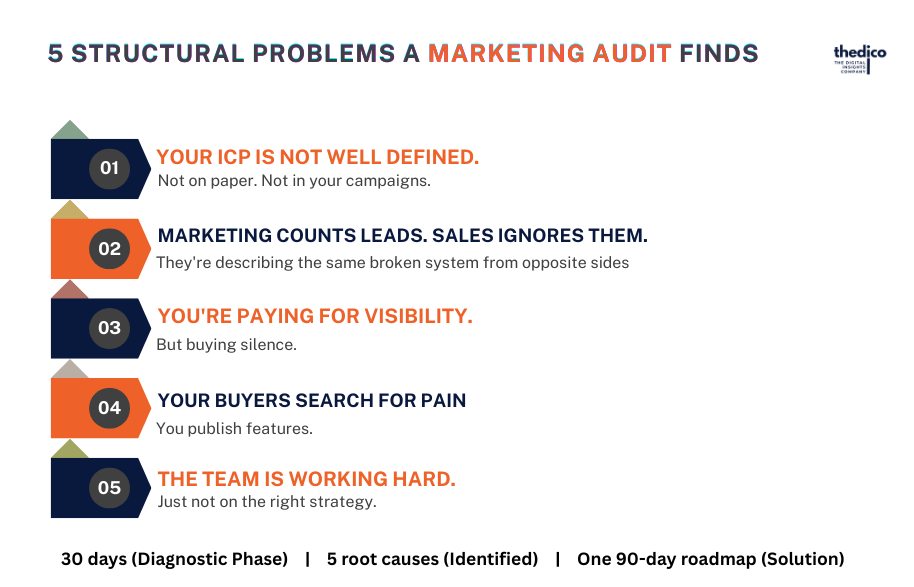
For most B2B companies in India, the audit surfaces one or more of five structural problems. Here is what they are, and what they mean for your business.
What does a marketing audit reveal?
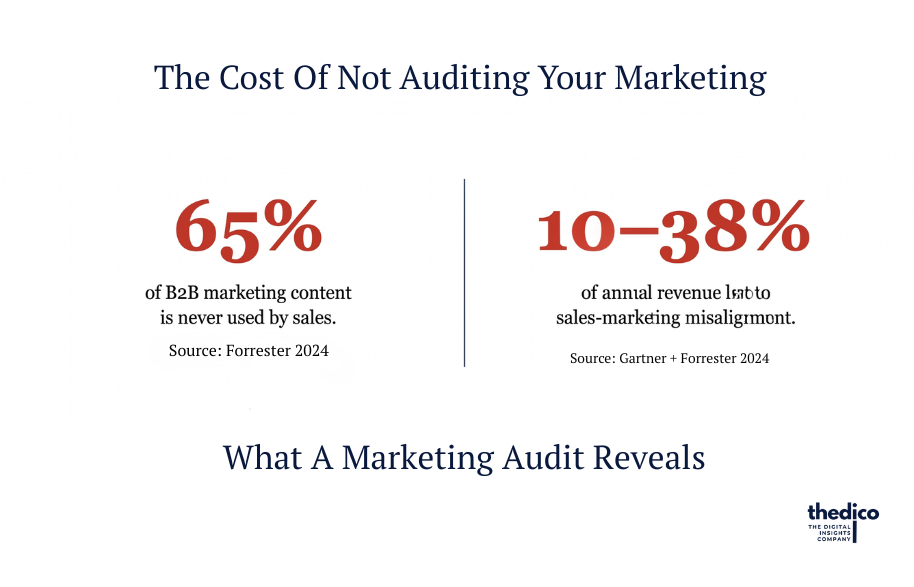
A marketing audit reveals the reasons a B2B business is not growing, which may be because of five root problems: targeting the wrong customer profile, a disconnect between sales and marketing, wasted budget on the wrong channels, messaging that does not connect with buyers, or gaps in team capability. For a mid-sized B2B company in India, a thorough audit takes 30 days and produces a 90-day action plan.
A Marketing Audit Finds Causes, Not Just Symptoms.
Most founders expect an audit to confirm what they already suspect. The website needs work, social media is inconsistent, and ad spend is too high.
Sometimes that is true. But a symptom review and a diagnosis are not the same thing. Knowing your leads are not converting does not tell you whether the problem is the leads, the messaging, the sales process, or the positioning. A B2B marketing audit that stops at symptoms gives you a long to-do list with no clear order of action items.
So, what is a marketing audit? TheDIco's marketing audit uses a 4P framework: People, Process, Product, and Platform. It looks at the whole growth system. Here is what it consistently finds in B2B companies at the 5 to 50 crore revenue stage in India.
01. The ICP Is Wrong or Has Never Been Defined
This is the most common finding in a marketing audit for B2B businesses, and it has the biggest downstream consequences. A business without a defined Ideal Customer Profile is not targeting anyone. It is broadcasting and hoping the right person sees it.
When the ICP is unclear, every other marketing element suffers. Messaging becomes generic, and sales chase deals that were never going to close. The founder ends up personally getting involved in every negotiation.
WHAT THIS LOOKS LIKE
An HR consultancy in Bangalore had positioned itself as 'HR solutions for all businesses.' Their content, ads, and sales decks targeted no one specifically. After redefining the ICP to manufacturing companies with 50 to 200 employees, conversion improved.
02. Sales and Marketing Are Running Separately
Marketing is generating leads, and sales is ignoring them. Or worse: marketing does not know what sales needs are, so the leads they generate are never going to convert. This is one of the core B2B marketing audit findings we see across industries, from manufacturing to IT services and HR consultancies alike.
Both teams look busy. Marketing is posting and running ads. Sales is on calls and following up. But they are not working from the same definition of a qualified lead or the same commercial goal. Interview both teams separately, and they will almost always describe the company's customers differently.
WHAT THIS LOOKS LIKE
A B2B kitchen equipment manufacturer was generating 60+ leads a month, but sales was closing just three. When we interviewed both the marketing team and the sales teams, we found they had never agreed on what 'qualified' meant. While marketing was counting on the enquiry form, sales expected a confirmed purchase timeline.
03. Budget Is Being Spent in the Wrong Places
When founders say, 'I am spending on marketing but cannot see where the money goes,' this is almost always what appears in the marketing audit. Budget is flowing to channels that feel active, be it paid ads, social media management, or event sponsorships, without any connection to revenue outcomes.
A marketing audit maps every rupee of marketing spend against attribution. Do you know that most of the time, companies allocate 60 to 70 per cent of their budget to channels with zero measurable impact on the pipeline? This is because there is no system to measure, learn, and redirect based on what is working.
WHAT THIS LOOKS LIKE
A SaaS company was spending 2.5 lakh per month on Google ads targeting generic keywords. Their organic blog content generated four times as many qualified inbound enquiries as paid content, at almost no incremental cost. The audit recommended reallocating the majority of the paid budget toward content and SEO. Cost per qualified lead dropped within two quarters.
Most founders are surprised by the findings. Book a free 30-minute call with Maran to find out what is actually holding your growth back.
04. The Messaging Does Not Match How Buyers Think
This is the one that founders find hardest to see from the inside, because your messaging makes complete sense to you. You built the service, you know every feature. But your buyer starts with a problem. If your messaging does not meet them there, it does not land.
Most B2B companies describe what they do – capabilities, credentials, process. But buyers are not asking 'what do you do?' The marketing audit compares your messaging to how your actual buyers speak and what makes them act.
WHAT THIS LOOKS LIKE
A supply chain technology company in Chennai was leading with an 'end-to-end visibility platform.' Their buyers' operations heads at mid-sized distributors were searching for 'how to reduce delivery delays.' After a messaging repositioning that led with buyer pain language, website enquiry conversion improved without any change to the product or pricing.
05. The Team Does Not Have the Skills the Strategy Requires
A founder builds a strategy based on what they have seen working elsewhere – content marketing, LinkedIn thought leadership, marketing automation. They hire a team to execute. But the strategy was never designed around the capabilities that actually exist.
Because it worked elsewhere doesn't mean it will work for you. When strategy doesn't work, results are mediocre, confidence drops, and the budget gets cut. The marketing audit reveals this by mapping required skills against the team's actual capability and makes honest recommendations either to hire, train, or bring in fractional CMO expertise for a limited period.
WHAT THIS LOOKS LIKE
An EdTech company had a two-person team executing a content-led inbound strategy. Both were good at design and social posts. Neither had experience in SEO, CRM workflows, or lead nurturing, all three of which the strategy depended on. The audit recommended one targeted hire and a 60-day skills plan. Within a quarter, the team was executing independently.
Most founders think they have a marketing problem. What they actually have is a clarity problem — and the audit is how you find out exactly where.
What a Marketing Audit Won't Tell You
It is worth being honest about this, because most consultants are not.
A marketing audit will not fix a bad product. If the market does not want what you are selling, no amount of messaging work or channel optimisation will change that. The audit will surface the signal, but fixing product-market fit goes beyond marketing.
It also will not replace execution. An audit produces a roadmap. The roadmap only works if someone acts on it. One of the reasons TheDIco stays through the 90-day implementation phase is this. The value is not in the findings document; it is in what gets built from it. Read more about how that works at TheDIco.
What Good Looks Like: B2B Marketing Audit to 90-Day Roadmap
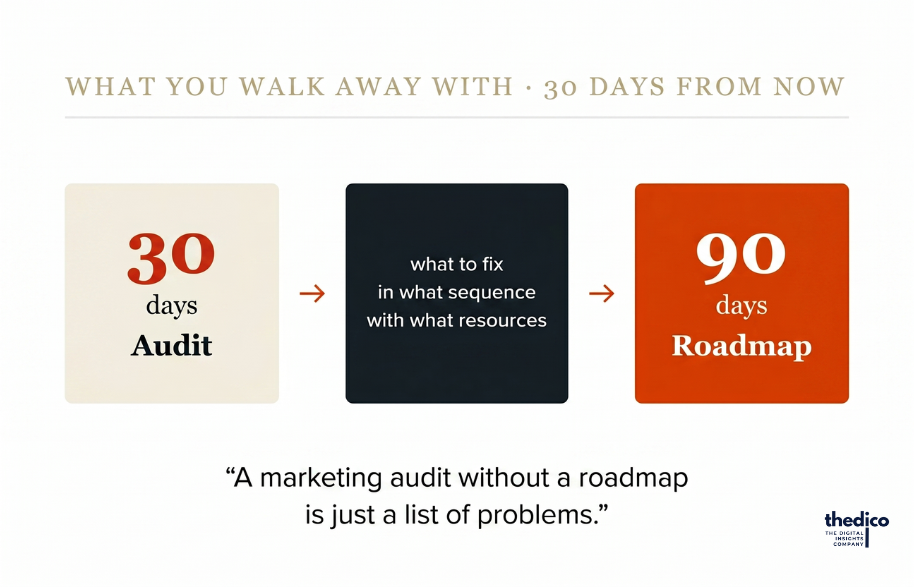
A marketing audit without a roadmap is just a list of problems. What TheDIco delivers at the end of 30 days is a 90-day action plan which includes what to fix, in what sequence, with what resources.
The 4P framework (People, Process, Product, Platform) makes sure nothing gets missed.
If you want to see what this looks like in practice, the Maxbyte Technologies case study is a useful reference. Maxbyte, a B2B technology company in the Industry 4.0 space, came to TheDIco with an unclear ICP, inconsistent messaging across channels, and no structured process for measuring marketing performance. Sound familiar? The 30-day audit covered brand reach, buyer personas, team capability, platform performance, and messaging consistency. The strategy that followed included a full STP model, channel optimisation, and a performance measurement framework built around KPIs that tied directly to revenue, not just marketing activity. The outcome wasn't just a report. Maxbyte engaged TheDIco for an ongoing consulting contract after the audit, because what was built was a functioning growth system, not a one-time deliverable.
Before Your Audit, What to Prepare
If you are considering a B2B marketing audit, having a list ready will make the 30 days significantly more productive.
Not sure if you're audit-ready?
Download the free checklist — 7 things to have ready before your marketing audit begins.
Wondering What Your Audit Would Actually Uncover?
Most founders are surprised by what a marketing audit reveals in their business. The problem they came in with is rarely the one we find.
TheDIco works with B2B companies in India including IT services, manufacturing, HR consultancies, and professional services, that have strong delivery but no reliable system to grow. We audit, build, and stay through execution.
Book a free 30-minute call with Maran
A straight conversation about what is holding your growth back, and whether an audit makes sense for where you are right now.
Frequently Asked Questions
What does a marketing audit reveal for a B2B company?
A marketing audit reveals the structural reasons a B2B business is not growing. This includes wrong ICP, sales-marketing misalignment, budget waste, messaging gaps, or team skill gaps. At TheDIco, findings are mapped against the 4P framework, so every problem has a clear owner and a clear fix.
What does a marketing audit include?
A B2B marketing audit includes a review of your ICP, messaging, monthly spend, sales-marketing alignment, team capabilities, CRM diagnosis, and overall channel performance. At TheDIco, this is a 30-day structured process involving platform analytics and team interviews. The outcome is a finding report and a prioritised 90-day action plan.
How long does a marketing audit take for a B2B company in India?
A thorough marketing audit India B2B engagement takes 30 days for a mid-sized company. This is enough time to identify primary causes rather than just symptoms. Shorter reviews consistently miss the structural problems, which is where the real growth is lost.
How is a marketing audit different from a performance review?
A performance review tells you what happened. A marketing audit tells you why. The structural reasons behind performance changes. One is backward-looking measurement. The other is a forward-facing diagnosis. TheDIco's audit goes beyond dashboards to find the underlying cause, turning a report into a roadmap.
Who should be involved in a marketing audit?
At minimum: the founder, the marketing lead, and the sales lead. Sales must be included because most root problems in a B2B marketing audit sit at the sales-marketing interface. An audit that only reviews marketing in isolation will miss at least half the picture.
How often should a B2B business do a marketing audit?
A B2B business should take a marketing audit every 12 to 18 months, but more frequently after major business changes. Many TheDIco clients use the marketing audit as a reset point when growth stagnates, before committing more budget to strategies.
Can a fractional CMO conduct a marketing audit for a B2B company in India?
Yes, and a fractional CMO is often better placed than an internal team because they bring an outside perspective without institutional blind spots. Maran conducts marketing audits across manufacturing, IT services, and HR consultancies in India as the entry point of every fractional CMO engagement.
Filed under
- Marketing audit
- Diagnostics
- ICP