A founder we spoke to recently runs a 60-person manufacturing company in Chennai. He has two people on his marketing team, a decent website, and a LinkedIn presence that he maintains himself. Growth has been flat for three quarters, and he kept wondering, why.
Somewhere in the middle of that, he'd started seeing the phrase "fractional CMO" everywhere on LinkedIn and asked us, half-serious: is that an actual job, or is it just consultants rebranding themselves?
It's a fair question. The term gets thrown around so loosely that most founders can't tell whether the role is a strategist, a freelancer, an agency in disguise, or something else. That confusion does exist: people either hire one when they shouldn't, or avoid one when it's exactly what they need. Before you decide whether you need this kind of leader, you need to know what one is.
What Is a Fractional CMO?
A fractional CMO is a full-time Chief Marketing Officer. The word "fractional" refers to time, not seniority or commitment. You get an experienced marketing leader for a certain period, not a junior version of the role.
This leader owns the marketing function: they set strategy, decide where the budget goes, lead whoever is executing, and remain accountable for whether marketing generates revenue. It's different from someone who hands you a plan and disappears.
In practice, a fractional CMO India engagement usually means a leader who has already built marketing systems across sectors like IT services, manufacturing, trading, and HR consulting, stepping in one or two days a week to give a growing company senior direction it can't yet justify hiring full-time.
What Does a Fractional CMO Actually Do?
A fractional CMO covers the strategic and leadership work of a CMO, not the daily execution. Here's what that looks like.
Marketing Strategy and Positioning
What is the company selling, to whom, and why should the buyer choose them over the competition? They define the ICP, sharpen the positioning, and set the go-to-market direction, deciding which channels to invest in and in what order.
Marketing Team Leadership
Most growing companies have one to three people doing marketing with no senior person guiding them. This leader gives that team direction, mentors and reviews their work, and turns scattered activity into a plan.
Sales and Marketing Alignment
In most B2B companies, these two functions quietly work against each other. They define what a qualified lead is, fix the handoff, and get both teams measuring success by the same number.
Demand Generation Oversight
Someone has to own how leads are actually created, not just counted. This leader decides which demand generation channels to prioritise and holds them accountable for pipeline, rather than activity.
Execution Management
A fractional CMO doesn't run the campaigns themselves. Your internal team or partner agencies handle execution; this leader manages them, sets expectations, and measures performance against the plan.
KPI and Metrics Ownership
If you can't answer "what is our marketing producing in revenue?", the first job is to make that question answerable, with the right KPIs, a reporting dashboard, and a review pattern that ties spend to pipeline.
Fractional CMO vs Consultant vs Agency vs Full-Time CMO
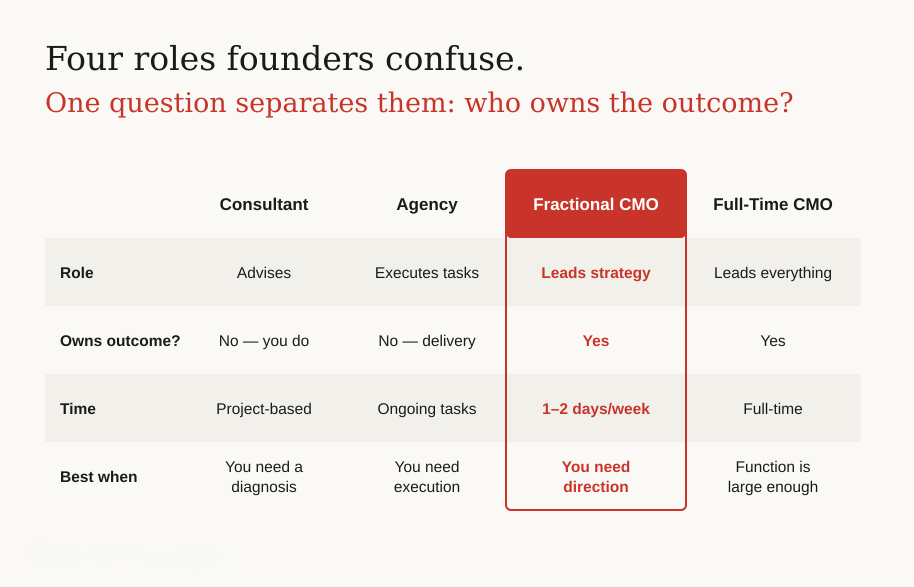
Founders confuse these four because they overlap on the edges. Here's the clean way to tell them apart, based on one question: who owns the outcome?
A marketing consultant diagnoses and advises. They find what's broken, build a roadmap, and hand it over for your team to execute. The outcome stays with you. That's the right choice when you need a diagnosis, not ongoing leadership.
A marketing agency executes. You give them a brief and a budget, and they run campaigns, produce content, or manage ads. They own delivery of tasks, not your overall strategy or its link to revenue.
A full-time CMO owns everything, full-time: strategy, team, execution oversight, board reporting. That makes sense when the function is large enough to need a senior leader forty hours a week.
A fractional CMO sits between the consultant and the full-time CMO. Like a consultant, they're external and part-time. Like a full-time CMO, they own the strategy and the outcomes, not just the advice, and they stay long enough to lead execution through your team.
Wondering what a fractional CMO would look like for your business? Book a free 30-minute call with Maran.
When to Hire a Fractional CMO: The Key Signals
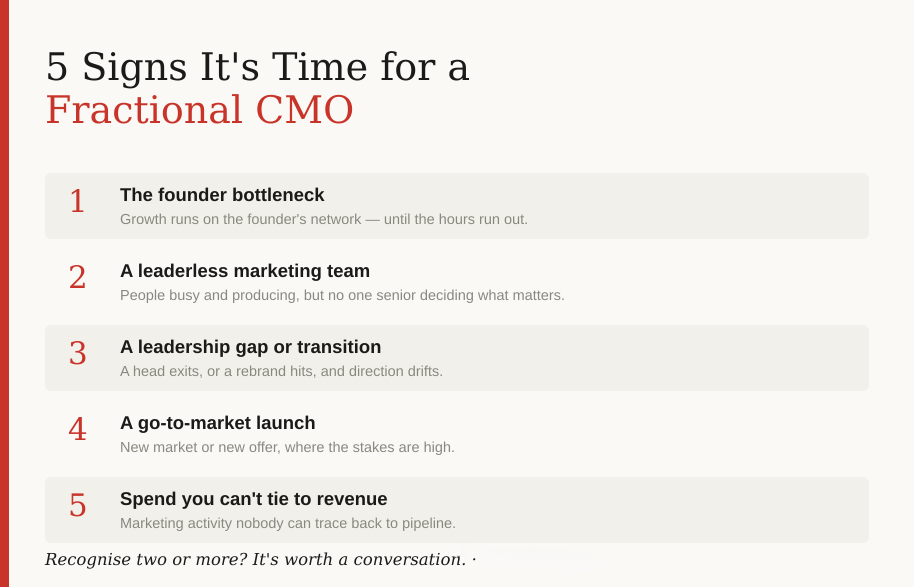
The right time to hire a fractional CMO is when you need senior marketing direction, but the work doesn't fill a full-time role yet. For most Indian B2B companies in the 20 to 100 employee range, these are the clearest signals.
The founder bottleneck
Growth has come from the founder's network and instinct. That works until the founder runs out of hours, and the pipeline stalls with no system to replace it. This is the most common trigger we see.
A leaderless marketing team
One to three people are doing marketing, staying busy, producing things, but nobody senior is deciding what actually matters. Effort is high, results are unclear.
A leadership gap or transition
When a marketing head exits, or during a rebrand or restructure, the gap isn't just execution, it's direction. Part-time leadership keeps strategy and continuity in place while you decide on the right permanent hire.
A go-to-market launch
When you're entering a new market or launching a new offer, the stakes are high and your existing assumptions may not carry over. This leader defines the positioning and sequences the channels so the launch creates measurable demand, not noise.
No marketing attribution
If the honest answer to "what is our marketing producing?" is a pause along with some traffic numbers, you have an attribution problem and activity nobody can tie to pipeline. You need someone senior to connect the budget to the business, and this is the point where a fractional CMO engagement earns its place.
When You Don't Need a Fractional CMO
This is the section most people selling the service won't write. This hire is wrong in three situations, and being honest saves you real money.
If you don't have product-market fit yet, no marketing leader can reliably create demand for something the market hasn't validated. Fix that question first.
If you only need execution, and you know exactly what needs doing, you need an agency or a freelancer, not a strategic leader. Paying for direction you don't need is waste.
If the work genuinely needs someone full-time, running a real team forty hours a week, a part-time engagement stretches too thin. At that point, hire full-time.
How to Choose the Right Fractional CMO
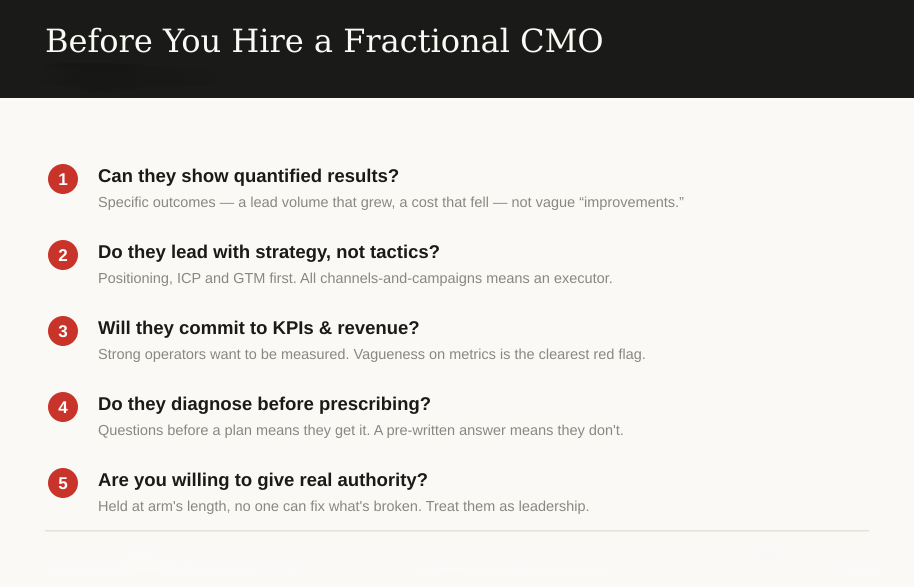
A few signals separate a genuine senior operator from someone who has simply relabelled themselves as a fractional CMO. Watch for these.
They can show quantified results
A genuine senior operator can point to specific outcomes from past work, like a lead volume that grew or an acquisition cost that fell, not vague claims about "improved performance."
They lead with strategy, not tactics
If the conversation is all channels and campaigns and never positioning, ICP, or go-to-market sequencing, you're likely talking to an executor, not a leader.
They embrace measurement
Strong operators want to be held to KPIs and revenue. Vagueness about how success will be measured is the clearest red flag there is.
They ask before they prescribe
Someone who diagnoses your business with questions before offering a plan is doing the job. Someone who comes with the answer already written hasn't understood the problem yet.
Fractional doesn't mean less. It means a senior leader for exactly the part of the problem that needs one, and nothing you'd be overpaying for.
What Good Looks Like: The First 90 Days
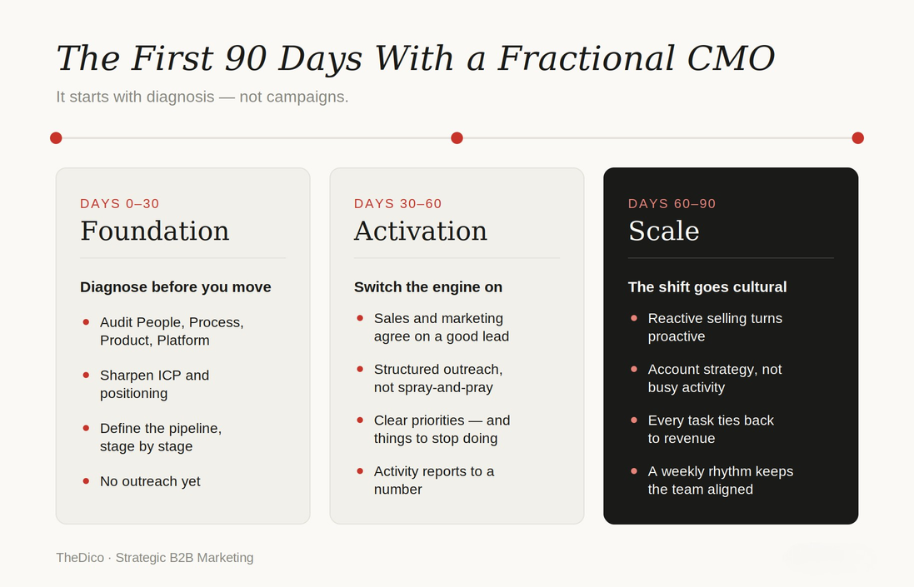
When the right fractional CMO steps in, the first ninety days follow a predictable shape. It doesn't start with campaigns, it starts with diagnosis. The audit comes before the action, and that sequence is what separates real marketing leadership from busy activity.
At TheDIco, that first-month audit is structured around four areas: People, Process, Product, and Platform, the same framework that anchors our audit and strategy engagements.
One thing determines whether any of this works: authority. A fractional CMO held at arm's length, without real decision-making access, can't fix what's broken. The companies that get the most from the engagement treat this person as a genuine part of the leadership team, not an outside adviser.
Signs a Fractional CMO Is the Right Fit
- Your growth has come from referrals or the founder's network, and that's slowing down
- You have a small marketing team but no senior person setting direction
- Sales and marketing regularly blame each other for poor results
- You can't clearly say what your marketing spend produces in revenue
- A marketing leader recently left and strategy has drifted since
- You're entering a new market or launching a new offer with high stakes
- You need senior marketing leadership but can't justify a full-time CMO salary yet
Frequently Asked Questions
What does a fractional CMO do?
A fractional CMO owns a company's marketing strategy and its outcomes on a part-time basis. They define the ICP and positioning, lead the existing marketing team, align sales and marketing, decide where budget goes, and build the measurement system that ties activity to revenue. Unlike a consultant who advises and leaves, a fractional CMO like Maran at TheDIco stays to lead execution through your team.
What is the difference between a fractional CMO and a marketing consultant?
A marketing consultant diagnoses what's broken, builds a strategy, and hands it over for your team to execute. A fractional CMO goes further, taking ongoing ownership of the marketing function part-time, leading the team and staying accountable for outcomes. In short, a consultant advises; a fractional CMO leads. TheDIco offers both, depending on whether you need a diagnosis or ongoing leadership.
What is the difference between a fractional CMO and a marketing agency?
A marketing agency executes campaigns: you give them a brief and a budget, and they deliver ads, content, or design. A fractional CMO owns the strategy those campaigns should serve, and stays accountable for whether marketing generates revenue. The agency delivers tasks; the fractional CMO owns outcomes and can even manage the agency on your behalf. At TheDIco, Maran leads strategy and holds execution partners to the plan, rather than running campaigns directly.
How many days a week does a fractional CMO work?
A fractional CMO typically works one to two days a week per client, though it varies with the stage and needs of the business. The point of the model is that senior marketing decisions and oversight don't require forty hours a week at most growing companies. You get the leadership when it matters without paying for full-time hours you don't need.
When should a B2B company hire a fractional CMO?
A B2B company should hire a fractional CMO when it needs senior marketing direction but the work doesn't yet justify a full-time hire. Common triggers include outgrowing founder-led marketing, having a team with no senior direction, a marketing leader leaving, entering a new market, or marketing spend with no visible link to revenue. TheDIco helps founders figure out if this is the right moment.
Can a fractional CMO work with a small marketing team?
Yes, and that's often the ideal setup. Many Indian B2B companies have one to three marketers who are busy but lack senior direction. A fractional CMO gives that small team a strategy to work toward, reviews their output, and turns scattered activity into a plan tied to revenue, without the company needing to hire another full-time salary.
Is a fractional CMO worth it for a mid-sized company?
For a mid-sized B2B company with real revenue but stalled growth, a fractional CMO is usually worth it, because the alternative is either drifting without direction or overpaying for a full-time executive the workload doesn't justify. The value is senior leadership and clarity applied to exactly the part of the business that needs it most, without the full-time cost. A short diagnostic conversation with Maran at TheDIco can tell you honestly whether it fits your stage.
Not sure whether a fractional CMO is what you actually need?
Start with a conversation. We'll tell you honestly whether this is the right move, or whether something simpler will get you there.
Filed under
- Fractional CMO
- Marketing leadership
- B2B growth