After two quarters of stagnant enquiries, a founder in Coimbatore hired a marketing consultant. The consultant delivered a detailed 12-page report, set clear priorities, and developed a 90-day plan based on the company’s data.
Six months later, the plan remained unused. The team lacked the authority to implement it, and the founder was too busy with daily operations to act. Although the advice was sound, no one in the company took ownership.
This is where the choice between a marketing consultant and a fractional CMO often fails. Founders tend to focus on fees and first impressions rather than who will own ongoing execution.
Marketing Consultant vs. Fractional CMO
Ask ten founders what separates a marketing consultant from a fractional CMO, and most will say price. That is not it. It comes down to six things. How long they stay. What you are left with once they leave. Whether they can direct your team or only advise it. How you pay them. Who owns the result at the end. And what problem each one actually solves. Once you see them together, the marketing consultant vs. fractional CMO decision gets a lot simpler.
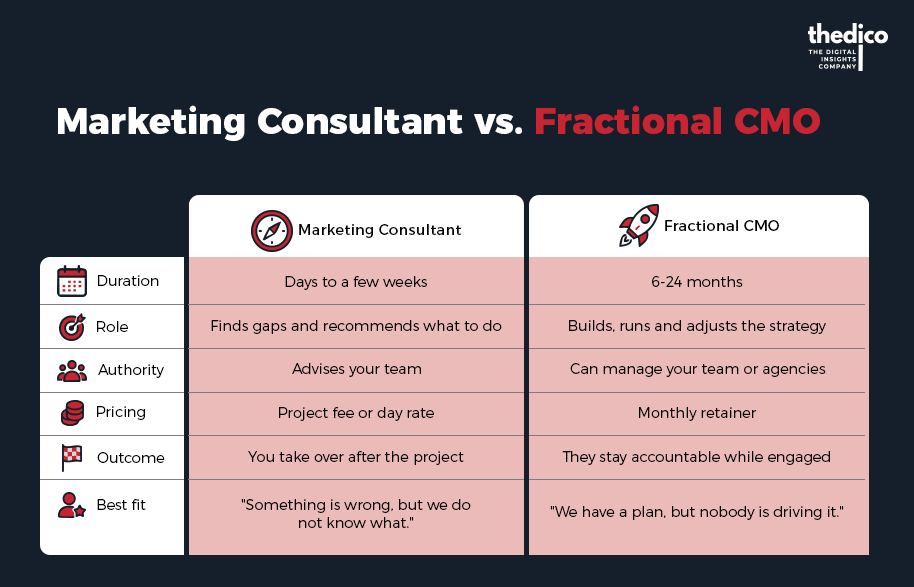
A consultant, like a marketing audit, tells you what’s broken and what to do about it. A fractional CMO stays on to make sure it actually gets done.
Fractional CMO Cost vs. Consultant Fees
For a mid-sized Indian B2B business, a fractional CMO charges a monthly retainer of ₹1.5 lakh to ₹5 lakh a month. An advisory-only retainer sits at the lower end, while an embedded role involving managing your team or agencies costs more.
A consultant is paid for a single deliverable, a project fee or a day rate. Once the plan is handed over, the fee is settled.
A fractional CMO is paid as a monthly retainer, depending on the hours committed per week: most commonly 6 to 12 hours.
For comparison, Naukri.com’s compensation data puts a full-time CMO’s annual salary in India into the ₹40 lakh to ₹80 lakh range for mid-sized businesses, before benefits or equity.
Quotes for this role vary widely, anywhere from ₹50,000 to ₹12 lakh a month for the same title. The number only makes sense once it is tied to specific hours and scope.
When to Hire a Fractional CMO vs a Consultant
From the outside, both hires look similar. The question that separates them is simple: once the advice lands, who owns the outcome, you or them?
A consultant diagnoses and hands off. The outcome stays with you. A fractional CMO takes the authority, and the outcome, with them. SHRM draws the same line: unlike consultants, fractional executives typically hold authority over people inside the company and can carry strategy through to execution.
So the rule is:
- Knowledge gap: you don’t know what to do. Hire a consultant.
- Ownership gap: you know, or a plan already exists, but nobody is driving it. Hire a fractional CMO.
If you choose the wrong option, it is not just a bad hire. It is a waste of one quarter and a budget line spent finding that out.
Signs You Need a Fractional CMO (vs. Just a Consultant)
It is a knowledge gap, so a consultant fits if:
- You can’t answer "what is our marketing producing in revenue?" with anything more than a pause and some traffic numbers.
- Your team could execute once someone senior tells them what to prioritize.
It is an ownership gap, so a fractional CMO fits, if:
- One to three people are already busy doing marketing, but nobody senior is deciding what actually matters.
- A strategy or plan already exists, maybe from a consultant you hired before, and nobody’s carried it through.
If the answer already exists and nothing is happening with it, that is not a knowledge problem. Bringing in someone to write another plan would not fix it.
When to Hire Neither
Sometimes the honest answer is neither. If you already know exactly what needs doing and just need it done, that’s an agency or a freelancer’s job. Paying for direction you don’t need is its own kind of waste. It is the same trap we have written about in why a marketing audit should come before you hire anyone.
The Practical Takeaway
Before you hire either one, do one check this week. Pull up your last three marketing initiatives and ask: did they stall because nobody knew what to do, or because nobody was responsible for finishing them?
Frequently Asked Questions
What is the difference between a marketing consultant and a fractional CMO?
A marketing consultant is hired for a short, defined period to diagnose problems and hand over a plan. Once delivered, the engagement ends, and the business executes the outcome. A fractional CMO stays embedded on the leadership team, builds the strategy, manages the people executing it, and stays accountable for the result.
How do I know if my problem is a knowledge gap or an ownership gap?
A knowledge gap means nobody can say what marketing is producing in revenue or what to prioritize next. A short consultant engagement fixes that. An ownership gap is different: a strategy already exists, sometimes from a consultant hired earlier, but nobody senior is driving it. Another plan will not fix that; you need a fractional CMO to own execution.
How long does a fractional CMO engagement last?
Fractional CMO engagements run six to twenty-four months, depending on scope and how quickly the marketing function needs to mature. That is long enough to build a real strategy, put a team or agency structure in place, and see whether results hold. A consultant engagement, by contrast, is scoped to a few weeks and ends once the plan is delivered.
Fractional CMO vs. full-time CMO: which one do I need?
A full-time CMO is beneficial if marketing is large enough to justify a senior salary and a permanent seat on the leadership team, usually past a certain revenue and team size. A fractional CMO offers the same seniority and ownership part-time, at a fraction of the cost, which is why most B2B companies hire one before they are ready for a full-time role.
How much does a fractional CMO cost compared to a marketing consultant?
A marketing consultant is priced per project or for a scoped block of hours, covering a single deliverable like a strategy document or an audit. A fractional CMO is priced more like an ongoing part-time leadership role, because the commitment and responsibility differ in kind, not just duration.
Is a fractional CMO worth it for a small business?
It depends on what already exists. A fractional CMO is worth it when there is already a team, a budget, or a set of vendors that need senior direction and accountability. Without any of that in place, there is nothing yet for a fractional CMO to lead, and the money is better spent on a scoped diagnostic first.
Can one person be both a consultant and a fractional CMO?
Yes, and it works in a better way. Splitting diagnosis and execution across two people means the one who built the strategy will not be accountable for running it, which is where handoffs break down. At TheDIco, every fractional CMO engagement with Maran starts with a structured audit, so diagnosis and ownership sit with the same person.
Filed under
- Fractional CMO
- Marketing consultant
- Hiring