Most B2B companies think their ICP is solid. They have an industry in mind, a size range, a set of target geographies, and on paper it looks like enough, and it does bring in a pipeline. Getting prospects in was never the tough part. Keeping them is, and that is where most of these ICPs fall apart.
The reason is simple: most B2B sales ideal customer profiles are built around assumptions that feel logical but do not predict what actually matters: whether a company will buy from you, get value, or stick around. Getting these criteria wrong hurts your conversion rate. It makes the messaging wrong, sends the sales team after the wrong accounts and makes it hard to learn what is working.
This post is not about building an ICP from zero. It is about the ten signs that tell you where yours is off, and what is actually behind each one.
Here is the part to focus on. Most of these signs don’t mean your ICP is wrong. They mean nobody actually owns it. Sales has one version of ideal, marketing has another. CS, where that function exists, has a third. Nobody has ever put the three side by side. That’s a system problem, the kind a Growth Readiness Audit is built to find.
10 Signs Your ICP Is Wrong, and Why They’re Not the Real Problem
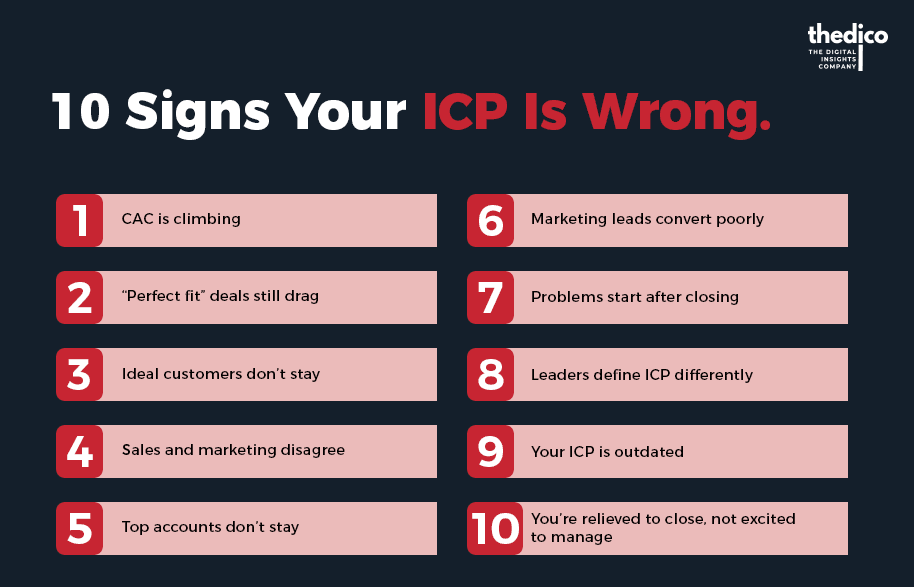
Most of these signs don’t mean your targeting is broken. They only show your ideal customer profile was correct once and nobody’s touched it.
1. CAC is climbing
You’re not losing more deals, but paying more to win them.
For example, a SaaS company spent ₹2.5 lakh a month on Google ads targeting generic keywords. At the same time, its own blog content was generating four times as many qualified inbound enquiries. Shifting budget toward content and SEO cut cost per qualified lead within two quarters.
2. "Perfect fit" deals still drag
Company fit and buying urgency aren’t the same thing. Your ICP tells you who looks right, not who is ready to buy.
For example, a capital equipment distributor in Tamil Nadu retrained reps to open discovery calls with the driving factors behind the decisions. It completely skipped the requirements. With this approach, the first-call qualification improved almost immediately, but fewer quotes went to prospects who fit the profile on paper but had no real reason to buy yet.
3. Ideal customers don’t stay
If ICP-matched accounts churn just as often as customers who don’t, your ICP isn’t telling you much about retention. That’s the number that should actually validate it.
4. Sales and marketing disagree
Both teams are scoring leads against different definitions that were never written down together. It’s one of the root problems a marketing audit uncovers.
A B2B kitchen equipment manufacturer was generating 60+ leads a month but closing just 3. Interviewed separately, marketing and sales had never agreed on what "qualified" meant. Marketing counted an enquiry form; sales wanted a confirmed purchase timeline.
5. Top accounts don’t stay
The largest logo is also the highest support load and the biggest churn risk. Revenue size and long-term fit are two different scores.
An HR consultancy in Bengaluru found 94% of its deals over two years traced back to the founder’s personal introductions. When she stepped back from business development for three months, the pipeline reduced by half.
6. Marketing leads convert poorly
The main gap is the ICP mismatch showing in CRM data. Nobody’s checked it for reliability — which is what a CRM audit is for.
Understand it from an example: a 40-person industrial equipment company in Coimbatore lost a returning client worth close to a quarter of one rep’s annual target. Two salespeople chased the same account while the client’s request sat unanswered in a WhatsApp thread. The CRM never flagged it, because nobody had checked whether the data inside it could be trusted.
7. Problems start after closing
What happens after the sale can reveal what your ICP missed. Industry and headcount don’t tell you how customers will use your product or whether they’re a good fit.
8. Leaders define ICP differently
If sales, marketing, and delivery can’t agree on the customer in one sentence, you don’t have an ICP. You have several private theories sharing a name.
An IT services founder came in convinced he had sales-related issues like a thin pipeline, two sales managers gone in eighteen months. The 30-day audit found the real problem: every campaign and outreach sequence targeted mid-level IT managers with no authority to sign, while the actual buyers were CTOs.
9. Your ICP is outdated
Your ICP was accurate when it was written. Now it’s describing a company that doesn’t exist anymore.
Here’s a real example: a materials business founder in Dubai had three rules — no outreach, no new hires, and no sharing of supplier information. A 40-year industry veteran accepted these rules with a condition: until his volumes are big enough to make those relationships secure. Months later, shipping costs tripled, and his margins took the hit. The condition had changed, but the rule stayed. That’s what happens with an outdated ICP. Read the whole story here.
10. You’re relieved to close, not excited to manage
There’s no metric, but founders know this one when it’s true. Relief means you may already be questioning the fit.
Frequently Asked Questions
What are the signs your ICP is wrong?
The clearest signs are rising CAC without a corresponding drop in close rate, "perfect fit" deals that still drag, on-profile customers churning at normal rates, and sales, marketing, and CS each describing your ideal customer differently.
What does it mean when your ideal customer profile is wrong?
It means nobody owns the profile, and it’s badly written, so sales, marketing, and CS have each drifted toward a slightly different version of "ideal" without anyone noticing.
How often should you update your ICP?
Never on a fixed schedule. Update it when pricing, product, or leadership changes. Those are the events that actually invalidate the profile.
Can sales and marketing have different ICPs?
No. Different definitions of ideal mean the pipeline is absorbing a disagreement the teams haven’t resolved, not specialization between them.
Is a good close rate proof my ICP works?
No. Close rate measures who said yes, not who stayed, expanded, or cost more to service than they were worth. Look at retention and expansion by segment instead.
Filed under
- ICP
- Sales and marketing alignment
- B2B growth