For B2B companies in India, a marketing audit typically takes 30 days and results in a clear 90-day action plan focused on improving marketing ROI and revenue impact.
Here is something we hear all the time from B2B founders in India: the budget has gone up, the team is working hard, the agency is sending reports, and yet, revenue from marketing has barely moved. Not because anyone is doing a bad job, but because nobody has stopped to ask whether the whole thing is pointed in the right direction.
If you have ever wondered what is a marketing audit and whether your business needs one, you are already asking the right question.
At TheDIco, we have worked with founder-led manufacturing and trading companies across India, most of them between ₹50 Cr and ₹500 Cr in revenue. The thing that surprises founders most after a marketing audit is not what was broken. It is how long it had been broken without anyone noticing.
Maran has run this audit inside 40+ Indian B2B companies over 20 years as a Fractional CMO. What follows is his framework, not one borrowed from a textbook.
What Is a Marketing Audit, And What It Is Not
A marketing audit for a B2B company is a structured review of your marketing functions, including your strategy, team, messaging, channels, and results, to identify what is working, what is not, and what needs to change.
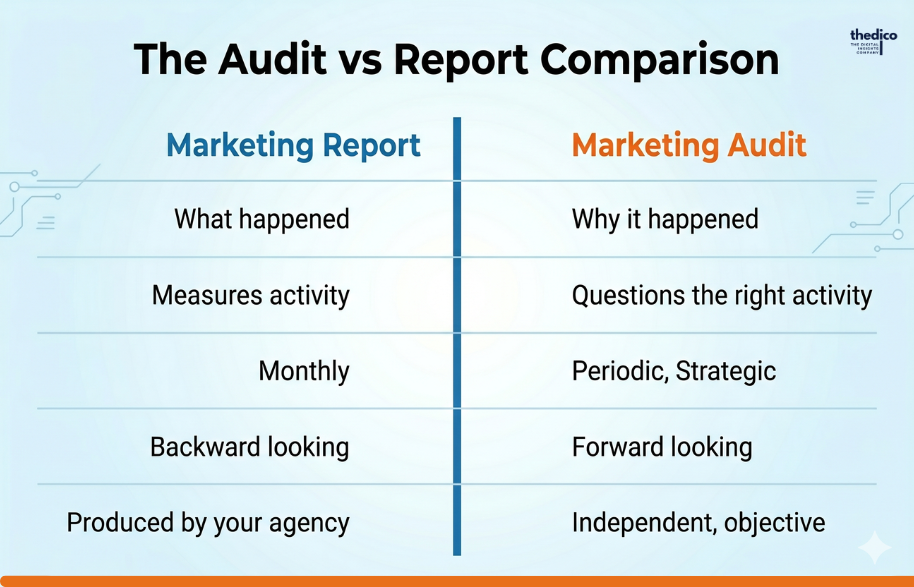
But here is the part most guides skip: a marketing audit is not the same as a marketing report.
A marketing report from your agency provides a monthly overview of clicks, impressions, and leads. It measures activities rather than effectiveness. A marketing audit asks whether the right things are being done in the first place.
What Does a Marketing Audit Actually Cover?
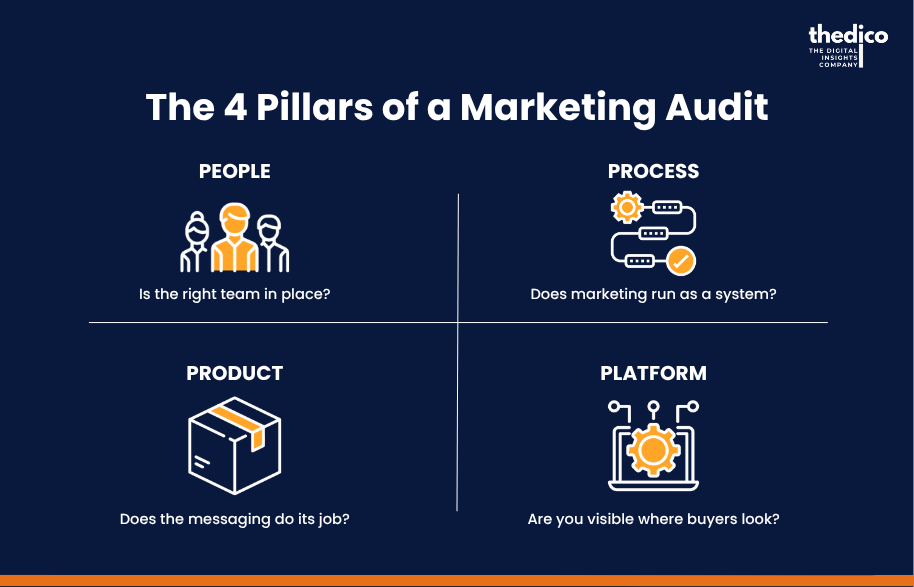
A marketing audit evaluates four areas. Whether you run a ₹60 Cr auto components plant or a ₹300 Cr industrial trading business, it starts with the same four questions.
People: Is the right team in place?
Who is doing the marketing, how capable are they, and are they working with clear direction? Many companies have talented individuals who are busy but not productive. Fixing that has nothing to do with hiring more people, but it requires fixing the system they are working within.
Process: Does Marketing Run As a System Or a Series Of Tasks?
Are there documented workflows, clear responsibility structures, and a defined handoff between marketing and sales? The most expensive inefficiencies are almost never in the campaigns. They are in the spaces between teams.
Product: Is the messaging doing its job?
Does your messaging speak to what your customers actually care about, or what you want to say? This is where most B2B companies quietly lose deals with a strong product but a weak story.
An audit that skips positioning and ICP clarity has skipped the part that matters most.
Platform: Are you visible where your buyers look?
A digital marketing audit in India often shows that companies are active on multiple platforms but are not coherent on any. The channels that consume the most budget are often not the ones driving the most pipeline.
When Should You Do a Marketing Audit?
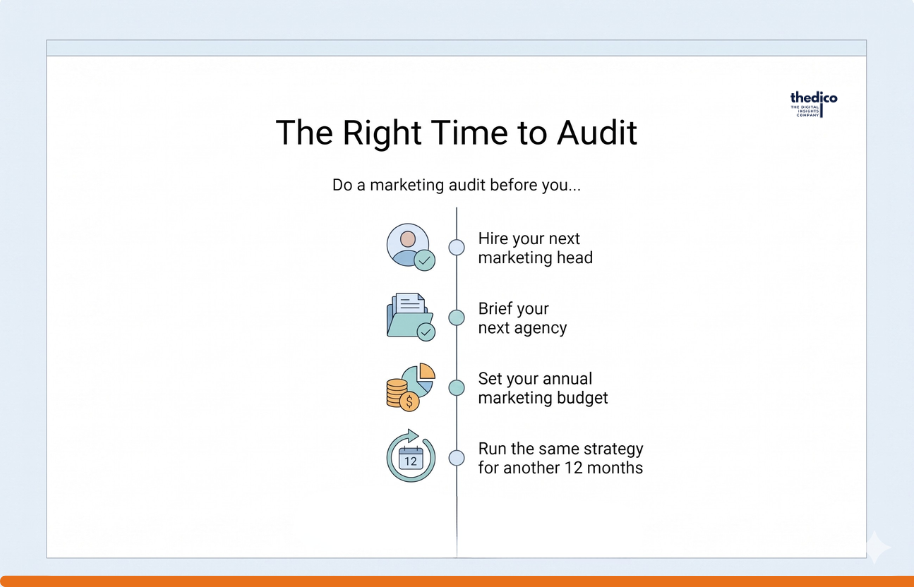
The right time for a marketing audit is not when things go wrong, because by then, the cost has already compounded. Do it before you hire your next marketing head, brief your next agency, and set your next annual budget. For founder-led B2B companies past ₹50 Cr, it is not optional. It is the foundation for every major marketing decision. And if you have been running the same strategy for more than 12 months without measurable improvement in your marketing ROI, that is not a sign to spend more. It is a sign to audit first.
What Maran Found Inside a 25-Year-Old PEB Manufacturer
A Pre-Engineered Building company in Tamil Nadu came to TheDIco in 2024 with a simple brief: generate more leads. Twenty-five years old, in-house manufacturing end to end, a good reputation among existing clients. Ask where those clients came from and the answer was always the same – word of mouth.
Maran ran the audit before touching a single campaign and found out lead generation was not the problem.
What the audit found:
- No sales team, not understaffed but completely absent.
- No defined process for identifying or approaching prospects.
- No CRM, no pipeline visibility.
- No training on how to handle an enquiry, follow up, or close.
- No outbound channels, digital or otherwise.
- A founder stretched so thin that even good leads went unfollowed.
The company was invisible to its own market. And when the market did find them, there was no process to convert interest into revenue. More leads poured into that would have changed nothing.
The audit also found something no campaign brief would have surfaced. The receptionist had been a lecturer before joining. Maran moved her into sales, where she became the single point of contact for every incoming lead. No job posting, no recruiter, no onboarding cost.
The result: first leads within 30 days. First ₹1 crore closure within 4–5 months. ₹10 crore in total contract value within six months, on zero paid media spend. The team grew from one founder doing everything to six or seven people running it without him.
None of that shows up in a monthly report.
Read the full breakdown: From Zero Pipeline to ₹10 Crore in 6 Months →
Do I Need a Marketing Audit? A Quick Self-Assessment For B2B Companies
According to HubSpot's 2025 State of Marketing report, only 52% of senior marketing leaders can actually prove the value of their marketing to the business. That means half of all marketing functions are running on faith rather than evidence.
The five questions below will tell you in under two minutes whether your business is in that half, and whether a marketing audit is what you need.
- My marketing team is active, but I cannot clearly explain what results they are driving.
- I am spending on campaigns or agencies, but conversions are not improving.
- My sales and marketing teams operate separately with little shared process.
- I have changed my marketing strategy more than twice this year without a data-driven reason.
- A competitor with an inferior product consistently gets more visibility than I do.
3 or more true: You have a structural problem, not a campaign problem. Audit now
2 true: Worth a 30-minute conversation before you spend another rupee on campaigns.
0 or 1 true: Your foundation is likely sound. Scale what is working.
Want to save this checklist? Download the free PDF version: print it, share it with your team, or use it before your next strategy meeting.
Download: Is Your Marketing Built to Drive Revenue? — Free Checklist →
What Happens After a Marketing Audit?
A well-executed marketing audit does not stop with a report. It ends with a prioritised 90-day action plan that includes what to fix immediately, what to build this quarter, and what to stop doing entirely.
The audit tells you where you are, while a strategy tells you where you are going. Without the audit, the strategy is guesswork.
Building a strategy without a marketing audit is like prescribing medicine without a diagnosis. It might work, but you are still guessing.
Want to see exactly what a marketing audit examines and what the 90-day plan looks like in practice? Read next: What Does a Marketing Audit Actually Reveal About Your Business?
Key Takeaways
- A marketing audit is a diagnostic review of your marketing function, not a campaign report.
- It covers four pillars: People, Process, Product, and Platform.
- Most B2B companies in India invest in marketing without ever auditing whether the foundation is right.
- A marketing audit uncovers structural gaps that no monthly agency report will surface.
- Two or more self-assessment points being true means your business needs an audit now.
Ready to Audit Your Marketing?
If your marketing isn't delivering the results your business deserves, the first step is to understand why, not just increase the budget.
If two or more of those self-assessment points rang true, the next step is a conversation, not another campaign.
Talk to Maran → thedico.in/contact-us
Frequently Asked Questions About Marketing Audits
What is the difference between a marketing audit and a marketing report?
Your agency's monthly report tells you what happened: how many clicks, how many leads, how the campaign performed. A marketing audit asks a harder question: should any of this be happening in the first place? One measures activity. The other questions whether that activity is even the right bet for your business.
How long does a marketing audit take?
At TheDIco, a B2B marketing audit runs over 30 days. That includes conversations with your team, a review of your channels and messaging, a look at your data, and ends with a 90-day action plan your team can actually execute, not a 60-page document nobody reads.
How is a marketing audit different from hiring a marketing agency?
An agency's job is to execute; a marketing audit's job is to ask whether what you are executing is even the right thing. Most founders hire an agency first and audit later, usually after months of disappointing results. Flip that order, and you will save yourself a lot of money and frustration.
When should a business do a marketing audit?
The best time is before a major marketing decision. It can be before hiring a marketing head, briefing a new agency, or setting an annual budget. If you have been running the same strategy for more than 12 months without measurable improvement, that is also a clear signal.
Filed under
- Marketing audit
- Diagnostics
- B2B growth