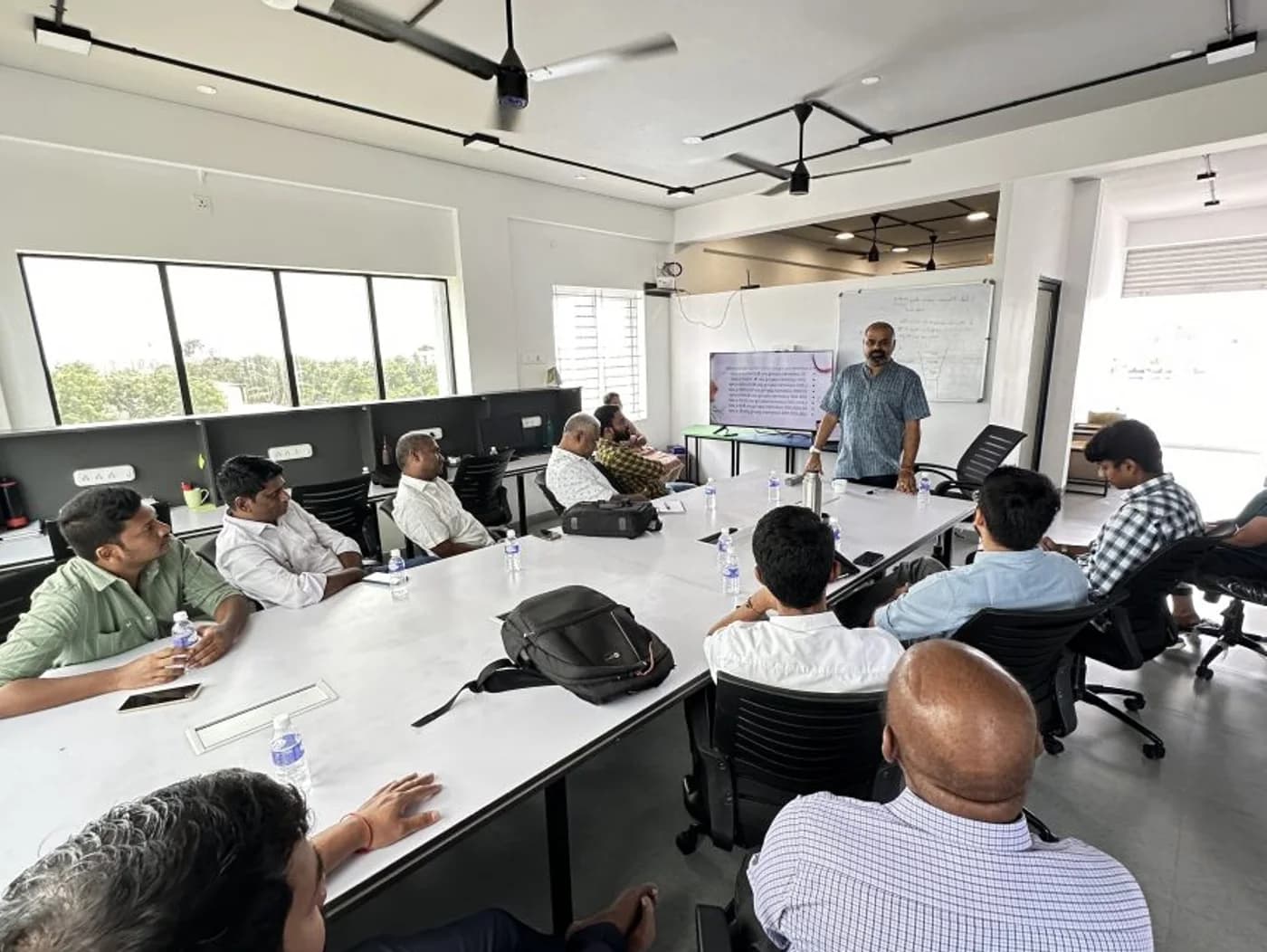
Building a business that runs without you means your team can make decisions, serve clients, and keep moving, whether or not you are available. It requires three things: knowing exactly where the dependency lives, pre-delegating access and authority before problems arise, and telling your team out loud that they are trusted to act.
Most founders are asked how to build a business that runs without them. Very few have actually tested it. Maran, Founder of TheDIco, decided to find out, he took a Monday completely off, phone away, and sent his team four honest questions the next morning.
What he found is not what most founders expect. The team didn’t fall apart. But what held them back had nothing to do with skill or knowledge but with permission.
This is what the experiment revealed, and the four habits that came out of it.
68% — Of business owners’ time goes to working in the business, not on it.
7/10 — Maran’s team score on running independently, one full day
5 — Times Maran’s team of 6 reached out in a full day. Not one task stalled.
The Detachment Report
Scoring Guide & Next Steps
The problem is not what you think it is

Most founders assume their team needs them because the work is complex — because only they have the context, the relationships, the judgment. And sometimes that’s true. But in practice, when Maran looked at what actually stopped his team on that Monday, almost none of it was due to complexity.
The blockers were boring. OTPs. Admin passwords. Account access that only Maran had. One afternoon of pre-delegating logins would have fixed most of it immediately.
The deeper issue was different, and more humbling. A few people on his team knew exactly what to do. They had the answer. They just weren’t sure they were allowed to act on it without him. They weren’t asking, “Can I do this?” They were asking, “Am I allowed to?”
That was more of a culture problem than a capability problem, and breaking it is the first step toward fully fixing the founder bottleneck.
The bottleneck wasn’t them needing me. It was me being available.
What the experiment actually revealed: 5 honest findings
Maran asked every member of his team the same four questions. He asked them to be honest. Here is what came back.
- FINDING 01. Most of the work didn’t need him, he was just used to being asked — Across six teammates and a full day, he was contacted five times. Not a single task stalled. The team didn’t need his input. They needed the habit of asking to go away.
- FINDING 02. The real blockers were administrative, not strategic — Every genuine blocker was access-related: passwords, OTPs, approvals for routine items. These are fixable in an afternoon. Pre-delegating access is one of the fastest ways to reduce founder dependency without changing anything else.
- FINDING 03. Some people are exceptional: they just don’t believe they are — One teammate wrote: “I would doubt myself whether I’m doing it the way you’d want.” She had the answer. She was waiting for permission that never needed to be asked for in the first place.
- FINDING 04. Some clients pause for the founder, that’s a positioning problem — A few clients said, “let’s wait until Maran is back,” even when his team already had the answer. This is not a team problem. It is the result of a founder who let himself become the face of every account, a different problem, with a different fix.
- FINDING 05. The best response was three sentences — “I realised it’s better to make decisions on my own than depend on you for small things.” No drama. Just a quiet change in thinking, and exactly the outcome the whole experiment was designed to find.
The 4 habits that actually build a 7- and then a 10
A score of 7 out of 10 is a starting point, not a destination. These are the four habits Maran identifies for reducing founder dependency over time. None requires a framework or a big restructure, just consistency.
- HABIT 01. Believe in them out loud — Belief that stays in your head helps no one. Maran’s approach: say it explicitly, “I think you can run this on your own.” The words do something that silence cannot.
- HABIT 02. Give permission before they ask — Tell the team often: “You’re allowed to try. You’re allowed to be wrong.” Repeat it until they stop asking for permission on small things, then trust them with bigger ones.
- HABIT 03. Push them just past comfortable — Once a quarter, hand someone a task a small notch above what they think they can do. Stay close enough to catch a fall, far enough that the win is theirs.
- HABIT 04. Treat new mistakes differently from repeated ones — First tries deserve acknowledgment. Patterns deserve a real conversation. Mixing the two up kills the appetite to try anything new.
What good actually looks like
A business that runs without its founder is not a business that doesn’t need him. It is one where the team keeps moving, makes good decisions, and serves clients well, whether the founder is in the room or not.
That change does not come from a single experiment. It comes from consistently doing four things: giving the team access before they need to ask for it, saying out loud that they are trusted, pushing them into slightly bigger responsibilities, and responding to mistakes in a way that keeps them willing to try again.
Most B2B founders Maran works with through TheDIco already know this intuitively. What they don’t have is a clear picture of where their specific business sits right now, and what the first, most practical thing to change is. The Detachment Report is the starting point for that conversation.
People also ask
How do I know if my business is too dependent on me?
The clearest sign is that decisions, approvals, and problem-solving consistently route back to the founder, even when the team is capable. If the team slows down when the founder is unavailable, if clients ask to wait until he or she is back, or if no real time off has been taken in months, the business has a founder dependency problem. The Detachment Report from TheDIco includes the exact 4-question audit to send the team this week.
What is founder dependency and why is it a problem?
Founder dependency is when a business can only move as fast as one person, the founder can personally approve, decide, and respond. It caps growth, creates burnout, and makes the business fragile. According to The Alternative Board, 68% of business owners spend the majority of their time working in the business rather than on it. TheDIco works with B2B founders across India to diagnose and fix this at the systems and team level.
How do I build a team that works without me?
The starting point is testing the current state — taking a planned day away and asking the team four honest questions afterward. Most founders discover the problem is not skill but permission: team members often know what to do but are waiting to be told they are allowed to act. The fix involves pre-delegating access, giving explicit permission to make decisions, and building a weekly rhythm where the team reviews progress independently.
What is the first step to stop being the bottleneck in my business?
The first step is finding out exactly where the dependency lives — not where it is assumed to be, but where it actually is. Most founders assume the team needs them for complex decisions. In practice, the blockers are usually administrative: passwords, approvals, account access. Pre-delegating these in an afternoon removes a large part of the problem immediately. The Detachment Report from TheDIco walks through how to build a business that runs without you, starting with this audit.
Can a small business in India run without the founder?
Yes, and the ones that do grow faster. In most Indian SMBs, the founder is the face of every client relationship and the approver of every decision — out of habit rather than necessity. Building independence is not about stepping away entirely. It is about creating the right conditions: clear processes, pre-delegated authority, and a team that is trusted out loud, so the business does not stall every time the founder steps back.