Most founders who want to know how to train a B2B sales team are asking the wrong question. They want better scripts, faster closes and sharper pitches. But the real problem is almost never the pitch — it is what happens in the two minutes before the pitch begins.
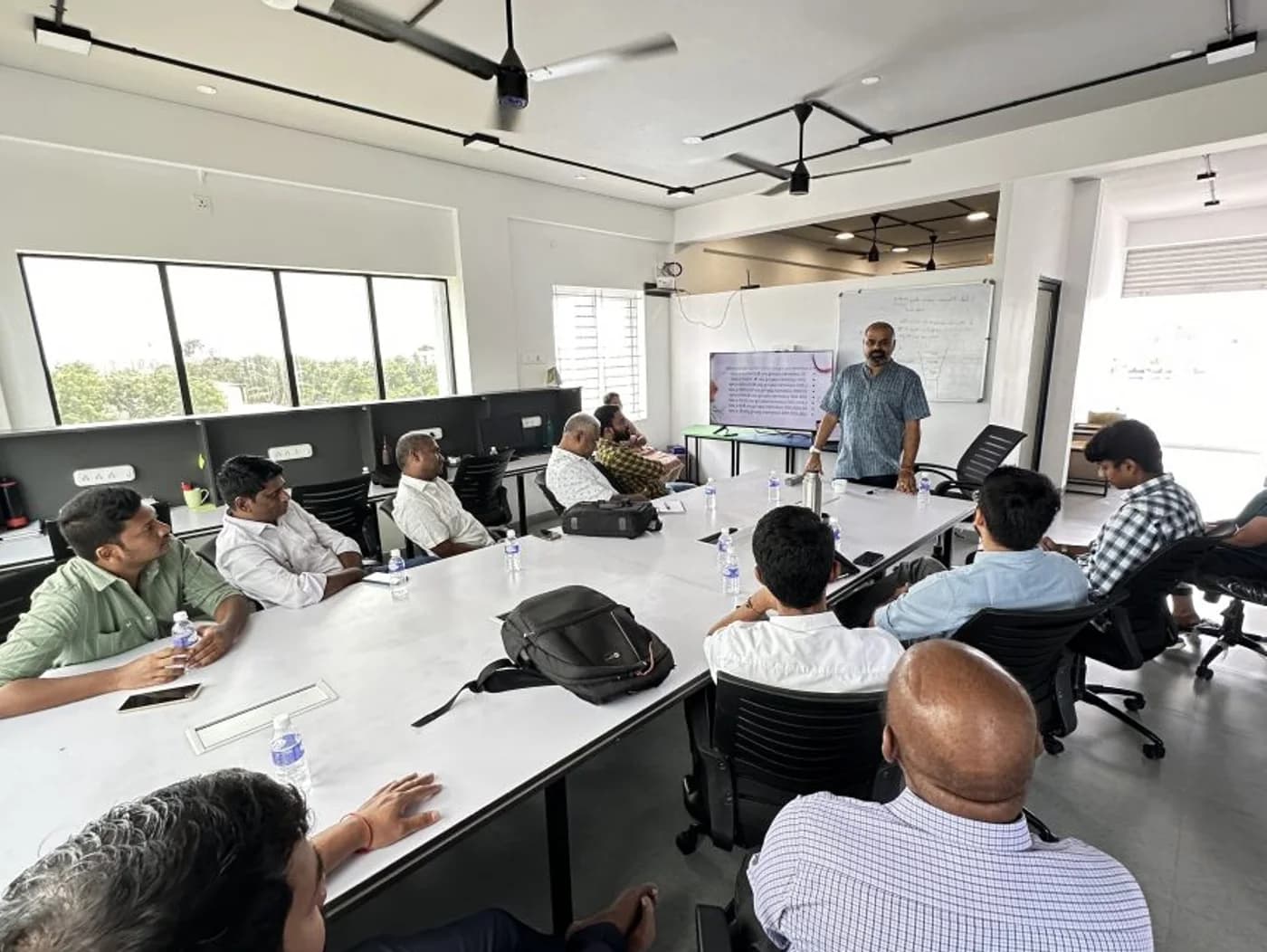
Maran, Founder of TheDIco, discovered this during a live training session with a South Indian industrial machinery company. Halfway through the session, he stopped teaching and picked up a cold lead — a masala manufacturer he had never spoken to before — and ran a live mock discovery call. He had never sold packaging machinery in his life. Within five minutes, the company’s technical head confirmed his pitch was 90% accurate.
The team in the room had sold this product for years. Maran had not touched it once. What he did differently is the subject of this article — and it is exactly what most B2B sales training programmes never teach.
Quick Answer
Training a B2B sales team to stop pitching starts with replacing product-first conversations with problem-first questions. This approach combines three things: a clear pre-call step that shapes how reps think before they dial, a structured set of moves for the discovery call itself, and a debrief practice that turns every real call into a coaching tool. Product knowledge helps, but it is not what closes deals.
38% — Sales training improves conversion rates by 38%. Continuous training produces 50% higher net sales per employee.
32 vs 23 — Top performers ask 32 questions per discovery call. Average reps ask 23.
44% — 44% of sales reps give up after one follow-up. Yet 80% of deals need at least five touchpoints to close.
Sell the Story, Not the Spec Sheet
The thing most B2B sales training gets completely wrong
Most B2B sales training in India is built around the product. Learn the specs, know the technical answers. Be ready when the customer asks how many units per hour, what the voltage requirement is, what the warranty covers.
That knowledge matters eventually. But it is not what converts a cold inbound lead into a booked follow-up call. What converts that call is something entirely different: the ability to ask the right question, at the right moment, in a way that makes the customer feel heard rather than processed.
The problem with most sales teams is not knowledge — it is method. And method is trainable in a way that product knowledge is not, because method is the same regardless of what you are selling. This is what Maran demonstrated in a single 5-minute call.
5 moves that closed a discovery call — without product expertise
During the live session, Maran made 11 moves across a 5-minute call. Here are the five that every B2B sales team can learn and replicate this week.
- MOVE 01. Open with the customer’s name, not a preamble — Most discovery calls open with “Am I speaking to…” or “I’m calling from…” — both position the salesperson as an intruder rather than a peer. Maran opened with: “Hello, Naveen. How are you?” First name, no corporate intro. The register for the entire call was set in one sentence. Real-world example: A packaging machinery sales rep in Coimbatore switched from “Am I speaking to the production head?” to first-name opens. His call acceptance rate improved within the first week.
- MOVE 02. Ask permission before the conversation starts — After the greeting, Maran said: “I just wanted to do a quick call. Is this a good time?” Asking permission reframes the caller from intruder to guest. It also earns the first micro-yes of the call — and micro-yes stack. Real-world example: A B2B HR services firm trained their team on the consent question. Average call duration increased because prospects were voluntarily staying on the line rather than politely waiting to hang up.
- MOVE 03. Ask why they are buying now, not what they want to buy — Before asking a single product question, Maran said: “What’s the purpose of this purchase?” This is the most important question in B2B sales. It skips feature discussion entirely and goes straight to the business reason. Purpose highlights pain; requirements show specs. Real-world example: A capital equipment distributor in Tamil Nadu retrained their team to ask, “What is driving this decision now?” instead of “What are your requirements.” First-call qualification improved — fewer quotes sent to unserious leads.
Wondering what this kind of sales training would look like for your team? Maran works directly with B2B sales teams to diagnose exactly where calls are breaking down.
- MOVE 04. Probe the second answer, not just the first — When Naveen said his machines were “very dusty,” Maran did not move on. He followed up: “Is the exhaust system already available in your factory?” That one question lead to a second, unspoken problem. This is the SPIN method’s implication question — and it is what expanded a single-machine deal into a machine-plus-exhaust-system conversation. Real-world example: A manufacturing sales team trained to always ask a second question after any problem statement saw average deal value increase because reps were regularly surfacing adjacent needs customers had not mentioned.
- MOVE 05. Stack three micro-commitments before closing the call — Before hanging up, Maran asked: “Can I send you a video? And I’ll also send a few questions on your email. Will you be able to answer those?” Three asks. Each asked as a question. Each requiring a yes. The moment Naveen said “Yes, sir” — he was psychologically committed to respond. Without this, the email dies in an inbox. Real-world example: A B2B IT services company in Chennai trained their outbound team on the triple-commitment close. Follow-up email open rates improved because prospects had verbally agreed to respond before the call ended.
Sales is never lost on the spec sheet. It’s lost in the silence between the questions.
What good B2B sales training actually looks like
The call Maran ran was not a demonstration of technical knowledge but of method. He asked questions in a specific sequence, listened for the second answer, expanded the problem without pushing, and collected three commitments before hanging up. The technical head of the company confirmed 90% accuracy, from a caller who had never touched the product.
This is what good B2B sales training looks like: not product memorisation, but conversational. Six beliefs installed before anyone dials a lead. Eleven moves practised until they become instinct. A debrief after every real call, in which the team scores itself against a framework.
TheDIco works with B2B sales teams across manufacturing, IT services, and HR consulting to build exactly this kind of practice. The full playbook — including the annotated call transcript, the 12 golden rules, and the 5-day rollout plan — is available as a free download from TheDIco’s resources page.
Your B2B sales training checklist — 8 signs your team needs this
- Your sales team sends quotations within hours of the first call, before understanding the real problem
- Inbound leads are treated like support tickets: call, ask what they want, send a price, move on
- Your reps freeze on calls when they can’t answer a technical question
- CRM notes read like product specs and call logs, not stories about the customer
- New leads sit for 24 hours or more before the first call is made
- Discovery calls run for 20 minutes but the rep still doesn’t know why the customer is buying now
- Follow-up emails are ignored because the prospect never agreed to respond before the call ended
- Your senior salesperson closes deals, but no one else on the team knows exactly what they do differently
People also ask
How do you train a B2B sales team effectively?
Training a B2B sales team effectively starts with installing a pre-call doctrine before teaching technique. Most programmes teach product knowledge first and conversation skills later. The most effective training does the opposite: it builds a set of beliefs about how buyers make decisions, then teaches a specific sequence of moves for the discovery call. Maran’s approach, documented in TheDIco Sales Playbook, uses a real annotated call to show the team exactly what good looks like, line by line.
What is the difference between consultative selling and solution selling?
Solution selling starts with the product and works backwards to the customer’s problem. Consultative selling starts with the customer’s business and works forward to the right recommendation. In practice, the difference shows up in the first question of a discovery call. A solution seller asks ‘what are your requirements?’ A consultative seller asks ‘what is the purpose of this purchase?’ One highlights specs, the other pain. TheDIco trains B2B sales teams in the consultative approach across Indian manufacturing and services companies.
Can a salesperson sell something they don’t know technically?
Yes — and a real example proves it. During a live training session, Maran ran a 5-minute discovery call for industrial packaging machinery he had never sold before. The company’s technical head confirmed the pitch was 90% accurate. The reason: the moves that convert a cold inbound lead into a booked follow-up call do not require product knowledge. They require a structured sequence of questions, empathy, and three micro-commitments before hanging up. Technical knowledge matters in the second call, not the first.
What is SPIN selling and does it work for Indian B2B companies?
SPIN selling is a framework from Neil Rackham’s 1988 research across 35,000 sales calls. It structures discovery conversations around four question types: Situation, Problem, Implication, and Need-Payoff. What made top performers different was asking Implication and Need-Payoff questions that average reps skipped. SPIN works well for Indian B2B companies, particularly in manufacturing and industrial sectors, where buyers have multi-layered problems that surface only when the right questions are asked in the right sequence.
How long does B2B sales training take to show results?
Conversational improvements are visible within the first week if training is paired with immediate practice. A sales team that installs the consent question, the purpose question, and the triple-commitment close from day one will see better call engagement almost immediately. Structural improvements — consistent pipeline quality and shorter sales cycles — typically take 4 to 8 weeks of reinforced practice. TheDIco’s 5-day rollout plan in the Sales Playbook is designed to operationalise the training immediately, not over a quarter.
What makes a good B2B discovery call?
A good B2B discovery call does four things: it opens with warmth rather than a corporate intro, it surfaces the real buying reason rather than the stated requirement, it finds a problem the customer has not mentioned yet, and it collects three specific commitments before ending. Most discovery calls fail because reps move too quickly from opening to pitching, without spending enough time in the diagnostic phase. The full annotated transcript from a real TheDIco training session, including all 11 moves and their psychological rationale, is available in the free Sales Playbook download.
Is your sales team product-ready but not conversation-ready?
TheDIco works with B2B companies in manufacturing, IT services, and professional services to diagnose exactly where discovery calls are breaking down and build the conversational system to fix it. If your pipeline looks full but conversions are stuck, this is where to start.